Updated September 2026Short answer: A/B testing does not hurt SEO when you follow Google's guidance: show crawlers the same variants as visitors, point a URL variant's canonical at the original, use temporary rather than permanent redirects, and end the test once it has its answer. Element tests inside one page add nothing new for search engines to index; URL split tests need the canonical.
The fear is reasonable. A split test creates a second version of a page that ranks, and nobody wants to find out three months later that the ranking moved to the copy or was split between the two. The good news is that search engines have been dealing with testing tools for well over a decade, Google has written down exactly what it expects, and every part of it is easy to satisfy.
Google's four rules for testing
Google's guidance on website testing comes down to four requirements. Everything else in this article is an application of one of them.
- No cloaking. Do not show Googlebot a different version from the one visitors see. Serving content based on user agent is the one thing that can get a site penalised, and it has nothing to do with testing as such; it applies to any page.
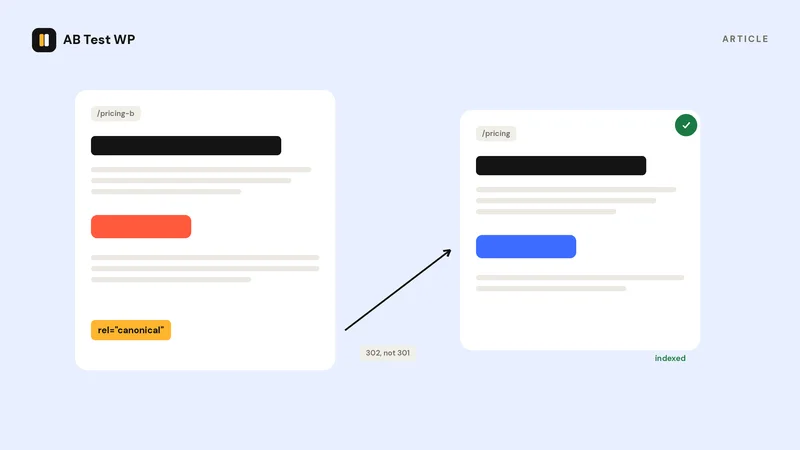
- Use rel="canonical". When a test uses more than one URL, the variant URLs should carry a canonical link pointing at the original, so that search engines index one page and consolidate its signals.
- Use temporary redirects. If visitors are redirected to a variant URL, the redirect should be temporary (a 302, or a JavaScript redirect), not a permanent 301. A permanent redirect tells search engines the original page has moved.
- Run the test only as long as necessary. Stop when you have a result, remove the variants or the redirect, and keep the winner as the page.
Notice what is not on the list. There is no rule against changing content with JavaScript, no rule against showing different visitors different headlines, and no rule against running many tests. Google renders JavaScript and sees whichever variant it happened to be assigned, exactly as a visitor would, and that is fine as long as it was not assigned deliberately.
Element tests: nothing to index, nothing to fix
An element test changes one thing inside a single page: the headline, a button, a section. There is one URL, one page in the index and one canonical. Both versions are in the HTML the server sends; a few lines of script show one and hide the other in the visitor's browser. When Googlebot arrives it is treated like any other visitor and rendered one version at random.
Three details keep this clean.
- Content parity. The variant should be a genuine alternative for humans, not a keyword-stuffed version for crawlers. If a variant would embarrass you as the permanent page, do not test it.
- The original stays available. With JavaScript off, the original renders and nothing is recorded. If JavaScript runs but the script itself is blocked, the two-second failsafe reveals the page rather than leaving content hidden, so a class-based element test shows both versions until you stop it. A crawler that does not execute scripts reads both versions in the HTML; only a client that reports scripting as disabled gets the control-only rule.
- No flicker, no layout shift. Anti-flicker rules hide the hidden variant before first paint, so the test does not add Cumulative Layout Shift, which is one of the Core Web Vitals. A two-second failsafe reveals the page if the script never runs.
In short, an element test is invisible to SEO. The only way to damage rankings with one is to ship a worse headline and leave it there.
URL split tests: where the canonical earns its keep
A URL split test sends part of the traffic to a second page, usually a redesign that is too different to swap element by element. Now there are two URLs, and rules two, three and four apply.
The variant page should carry a canonical link pointing at the original. Google treats the two as one page and keeps the original in the index; the variant is understood as a temporary alternative rather than a duplicate. This is the setting to use in almost every case, and it is what Google's guidance describes.
There are two alternatives. The variant can be marked noindex, which keeps it out of search results entirely; this is the safer choice when the variant must never surface on its own, for example a page built only for a campaign. Or SEO handling can be turned off, which leaves whatever your SEO plugin outputs, and is only right when you have set the canonical there yourself. What you should not do is leave two indexable pages with no canonical relationship between them and hope.
The redirect itself should be temporary. A redirect that runs in the visitor's browser, in the page head, before anything paints, satisfies this: the original URL still exists, still returns its content, and is still the page search engines see as canonical. A server-side 301 would do the opposite, telling search engines the original has moved for good.
Ending tests, and why it matters more than people think
Rule four is the one most often broken, and not by tools. A test that reached its sample in three weeks and is still redirecting half the traffic five months later looks, to a search engine, like a slow-motion migration. Decide the sample size before the test starts, use the sample-size calculator so the finish date is known, and when the result is in, either ship the winner as the page or remove the variant. If you want to keep showing the winner to visitors while you rebuild the real page, do that with the test's keep-showing-the-winner setting, not by leaving the experiment running.
What about Core Web Vitals?
The one measurable way a testing tool can affect rankings is by slowing the page or shifting its layout. Cloud tools load a script from their servers on every page, often with an anti-flicker snippet that blanks the page until the script responds. A tool that inlines its rules, loads a small deferred script, and keeps the tested element hidden until the assigned variant is applied adds nothing meaningful to Largest Contentful Paint or Cumulative Layout Shift. Check the numbers on a tested page in PageSpeed Insights before and after; that is the whole audit.
How AB Test WP handles each rule
- No cloaking: variants are assigned at random in the browser; crawlers are not detected or treated differently. Known crawlers are simply not counted in the results.
- Canonical: the default for a URL test points the variant's canonical at the original; noindex and off are the other two settings, chosen once in the plugin's settings and applied to every URL test on the site. It works with Yoast, Rank Math, All in One SEO and SEOPress. Canonicals are not emitted when the variant is on another site.
- Temporary redirect: the redirect runs in the page head in the visitor's browser, not on the server, so the original URL keeps serving its content and cached pages work.
- End the test: the built-in sample-size planner sets the finish line before the test starts, and the keep-showing-the-winner option serves the winner to everyone, with no further tracking, until you have edited the real page.
The SEO settings for URL tests page documents the three options.
A checklist before you start a URL test
- The variant's canonical points at the original, or the variant is noindex.
- The redirect is temporary and runs only while the test is running.
- The variant is a page you would be happy to rank, in case it is seen.
- The sample size and the finish date are decided.
- The winner will be shipped as the page, and the loser removed or redirected, when the test ends.
Google's own page on the subject is Website testing and Google Search. It is short, and everything above is consistent with it.
Sources
- Website testing and Google Search, Google Search Central, checked September 2026
- Redirects and Google Search, Google Search Central, checked September 2026
- Canonicalization: consolidate duplicate URLs, Google Search Central, checked September 2026
- Cumulative Layout Shift, web.dev (Google), checked September 2026
Common questions
Does A/B testing hurt SEO?
Not when it follows Google's published guidance: show crawlers the same variants as visitors, point a URL variant's canonical at the original, use temporary redirects, and end the test when it has its answer. Element tests inside one page add nothing for search engines to index.
Is changing content with JavaScript a problem for Google?
No. Google renders JavaScript and sees the variant a real visitor would see. The rule is that crawlers must not be singled out for different content; a random split that includes Googlebot is fine.
Should the variant page be noindex or canonical?
Canonical, pointing at the original, is Google's recommendation and consolidates signals on one URL. Noindex also works and is the safer choice when the variant must never appear in search results on its own.
How long can a test run before it becomes an SEO risk?
Google asks that tests run only as long as needed to get a result. A test sized in advance and ended when the sample is reached is fine; a redirect left in place for months starts to look like a permanent move.